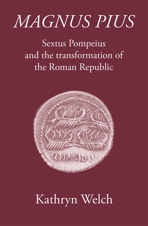
Magnus Pius:
Sextus Pompeius
and the Transformation of the Roman Republic
By
Kathryn Welch
ISBN 13-978-1-914535-39-0,
paperback, 2024
ISBN 13: 9781905125449, hardback,
350pp. 2012,
Sextus Pompeius Magnus Pius, son of Pompey the
Great, fits uneasily - or not at all - into the grand narrative of
the civil war of 49-31 BC. Modern scholars tend to exclude him or
mention him without asking what or whom he represented. Ronald Syme,
the father of international orthodoxy in this field, famously remarked
that Sextus was ‘in
reality an adventurer’ who was ‘easily represented as a pirate’. He was wrong.
Sextus Pompeius plays havoc with key elements of the accepted narrative. His
military success destroys the myth of continuous Caesarian victory. His commitment
to rescuing the victims of Triumviral violence belies claims that only the Caesarian
side represented clementia and justice. The naval strategy by which he conducted
the war demonstrates his commitment to the same cause and ethics as his father
and his father’s allies. Welch argues
that, far from being a ‘side-show’ or a ‘bit player’, Sextus Pompeius was integral
to the
fight for the respublica. She solves the ‘problem’ by placing him at the centre
of the story of
Rome’s transition from Republic to Empire and so reveals a very different landscape
that
emerges as a result.
Contents
1. The lost Republic
2. Sons of Neptune
3. The Pompeian inheritance
4. Refashioning Republicanism after the Ides of March
5. A Republican Triumvirate?
6. Pompeianum tempus
7. Bellum Siculum
8. Pietas at the dawn of the Principate
Appendix: Imp. and Imp. iterum: an unreliable guide to dating