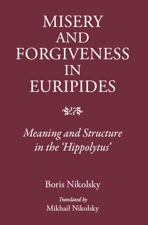
The tragedies of Euripides are among the most
admired works of Greek literature. They are valued especially in
our own day for their sceptical attitude to authority and divinity,
for their psychological complexity and for their sympathetic but
unsentimental portrayal of assertive women. In this striking new
monograph, Boris Nikolsky reinterprets a Euripidean tragedy which
combines these qualities to the highest degree, the Hippolytus.
Nikolsky questions the current gender and psychoanalytical approaches
to Hippolytus and challenges the widespread interpretations of
the play as being concerned with the irresistible force of love
and the inevitability of punishment for those who underestimate
its power. He reads the play in terms of its own culture and argues
that Euripides' primary interest lies rather in the sphere of morality.
Arguing from the dramatic structure of Hippolytus, its imagery
and the problems of its production, the author proposes a new interpretation
of the play's main theme: humans turn out to be not culprits but
victims of fate, their will always tends towards virtue, but their
natural weakness and the ambivalence of virtue itself lead them
to wrong actions.
In consequence, it is exoneration and forgiveness that are shown
to be the highest and only pure moral values.
About the Author
Boris Nikolsky is a graduate of Moscow State University and of
the Russian Academy of Sciences, Moscow. Since 1995 he has been
teaching Classics at the Russian State University for the Humanities
in Moscow, and since 2013 is Principal Research Fellow at the School
of Humanities of the Russian Presidential Academy of National Economy
and Public Administration. He has been Junior Fellow at the Center
for Hellenic Studies in Washington (2002-3), Diderot Fellow at
the University of Grenoble (2007), and Fulbright Fellow at Brown
University (2010). He has also published a commentary on Cicero’s
De finibus (2000, in Russian).
|