For sales information, please contact our distributors:
Mare Nostrum Group
For North American and all e-book sales:
ISD Distribution www.isdistribution.com


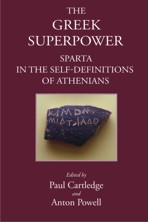
  The Greek Superpower. Sparta in the Self-Definitions of Athenians.
Edited by Paul Cartledge and Anton Powell
ISBN: 9781910589632, hardback, 280pp, 2018,
 

Even Greeks – in later times – saw Athens as ‘the Hellas of Hellas’, the moral standard-bearer of Greek civilisation. But in the classical period many Athenians thought otherwise: Athens might be a school of Hellas, but the school of Hellas was Sparta. Spartan soldiers dominated the Greek mainland and beyond, and in 404 bc Sparta enforced the total military surrender of Athens. The cause of this supremacy was seen as the uniquely harmonious subordination of Sparta’s citizens to their city’s interest.

This book explores Athenians’ thinking about Sparta’s military and moral ascendancy. In nine new studies from a distinguished international cast, the works of Athenian politicians, writers and artists are examined so as to reveal mentalities in the wider city which, at the extreme, might cause Athenians to revere Sparta even as they fought her. Such respect culminated not only in Plato’s literary creation of fantasy cities (in the Republic and Laws) which imitated Spartan methods, but even in a short-lived claim by ruling Athenian politicians that Athens, after its military surrender, was to be remodelled as itself a New Sparta.


Contents

Introduction: Paul Cartledge & Anton Powell
Carol Atack: `The kings and I: Athens and Sparta in Isocrates' imaginary'
Edith Hall: `Euripides, Sparta and the self-definition of Athenians'
Fritz-Gregor Herrmann: `Plato's Republic as ideal version of Sparta?'
Marcello Lupi: `Gained in translation: Spartan syssitia and Athenian oligarchical vocabulary'
Ellen Millender: `Athens, Sparta and the techne of deliberation'
Anton Powell: `Athens as new Sparta? The revolution of 404-3'
Nicolas Richer: `The contribution of Spartan practices to Xenophon's political and moral thought'
Ralph Rosen: `Sparta and Spartans in Old Comedy: paradox, genre and meaning'
Malcolm Schofield: `Aristotle's critique of Spartan imperialism'
Michael Scott: `Architectural and artistic responses to Sparta'


Classical Review 2019, 509-11.

"The quality of analysis in the volume, which is clearly aimed at a specialist audience, is consistently high. It is noteworthy that the authors (presumably with assistance from the two editors, both eminent scholars who have written numerous, highly influential books and articles on Sparta) escape almost entirely the pitfall of, as Debnar puts it (p. 2), finding a Spartan lurking behind every clause." Paul Christesen,

CJ-online 2021.08.03.

"In sum, Powell and Cartledge's book clarifies evidence for the Spartan mirror in which Athenians could refine their self image: wits and warriors both, rulers of themselves and others, and the self praised Hellenists of Hellas. Further, their authors present new elements of the otherwise lacunose Spartan image in the pre-ponderantly Athenocentric literature of the 5th and 4th century Hellas.The familiar russet dust jacket lists thirteen published volumes in the Lakedaimonian seriesand four more"forthcoming" This impressive volume complements its congeners." Donald Lateiner,

Classical Philology 2019, 575-80.

"It is commendable for its recruitment of scholars who do not ordinarily do research on Laconian matters, but who contribute valuable insights here. The complexity of Attic attitudes about Sparta is brought out well, although the ideological dynamic driving them is necessarily elusive in such a collection of conference papers." Thomas Figueira, Classical Philology 2019, 575-80.