
|
|||
|
|||
|
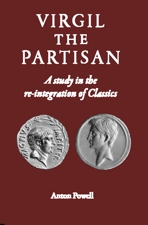
Virgil the
Partisan. A study in the re-integration of Classics |
||||||||
| ISBN 13: 978-1-905125-54-8, paperback, 310 pp, 2012, | |||||||||
Awarded the prize of The Vergilian Society of America for best book on Virgil (2011). From the Society's citation: “...the contribution of this book lies above all in the compelling argument that the political and military history of the 30s BC is more important for an understanding of all three of Virgil's major works than it is often taken to be...Powell's Virgil is unashamedly pro-Octavian, pro-Augustus, a poet one of whose main goals was to address and palliate the weakness and unpopularity of Octavian. This is not a fashionable approach to Virgil, and doubtless many will resist Powell's political reading. But it will be impossible in future to ignore Powell's careful and detailed arguments for the centrality of the historical context...” Philip Hardie and Julia Dyson Hejduk |
|||||||||
| Since its first appearance in 2008, this book has changed
the landscape of Virgilian studies. Analysing closely the logic and the literary
genres of Virgil's three poems, it politely confronts the modern orthodoxy
that Virgil signalled distaste for the methods of his ruler, Octavian-Augustus.
It refreshes the study of Virgil's poetry by comparing it with the detail
(normally neglected by scholars) of Rome's civil wars after Julius Caesar's
death, when Octavian's survival looked highly unlikely. And it argues that
Virgil wrote as a passionate - and brave - partisan of Octavian, who - like
a good lawyer - confronted his patron's undeniable failings in order to defend. The author Anton Powell is the author of Athens and Sparta (1988, 2001) and the editor (with Stephen Hodkinson) of volumes generated by the International Sparta Seminar, which he founded. Editor of The Greek World (1995), he has also edited Roman Poetry and Propaganda in the Age of Augustus (1992) and, with Kathryn Welch, Julius Caesar as Artful Reporter (1998) and Sextus Pompeius (2002). Powell is Director of the University of Wales Institute of Classics and Ancient History. He founded the Classical Press of Wales, of which he is general editor. Tis is its 59th volume. He has twice been professeur invité at the Ecole Normale Supérieure in Paris, in 2006 for Greek history and in 2008 for Latin literature. |
|||||||||
|
|||||||||
 |