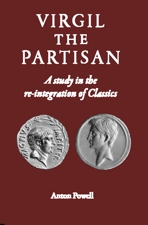
Review 1: Mnemosyne
63 (2010) by Stephen Harrison, Corpus Christi College,
Oxford
This stimulating volume seeks to put the party politics back
into Virgil's oeuvre, and rightly considers the poetry in its
relationship to the complex political environment of the Triumviral
and early Augustan period.
P. sees political partisanship as the fundamental motivation
for all Virgil's works; in particular, P. believes that Virgil
was consistently concerned to defend Octa-vian/Augustus against
the powerful opposition and legacy of Sextus Pompeius, who
had made life difficult through both successful naval warfare
and effective blockading of Italy in the period 43-35. Here
P. is clearly right to stress that Sextus might be expected
to feature in contemporary Triumviral literature, but not all
will follow his insistence of the importance of Sextus for
the Georgics and Aeneid. Dying in 35 BCE, Sextus surely meant
relatively little for the new post-Actium world, and P. may
exaggerate his significance even during his lifetime, though
his role as natural heir of Republicanism as well as of Pompey
was clearly significant (as acknowledged e.g. by Josiah Osgood
in Caesar's Legacy (2006), 202-7). P. rightly presents
Sextus (through his preferred name 'Magnus Pius') as a self-proclaimed
champion of pietas\ but (as he recognises) the same can of
course be said of the young Caesar, divi filius and
contriver of his adopted father's apotheosis. Such rivalries
were symptomatic
of inter-dynast competitions for symbolic roles: we could add
that of being the new Alexander or of being Liber/Bacchus,
both clearly contested by the young Caesar and Antony. P. s
good account of pietas in the Aeneid rightly stresses that
it can encompass revenge (whether for Pompey or Caesar) as
a key
feature of loyalty: this crucial link, often underestimated
by moderns though not by Augustus himself (Res Gestae 2),
certainly informs the evaluation of revenge as an acceptable
ending for
Virgil's epic, as P. well argues.
Not all will agree with P.'s presentation of the Aeneid as
being strongly concerned with answering anxieties about the
young Caesar's behaviour in the trium-viral period: after Actium
and the adoption of the name of Augustus, the promotion of
the ideology of the self-proclaimed new era was surely more
important for Cae-sarians than defending past failings. P.
suggests that V. is strongly concerned to mask the overt impietas
of the proscriptions of 43 BCE; these were shocking indeed
(e.g. the death of Cicero), but their invidious legacy was
effectively countered by the young Caesar's decision not to
have proscriptions after Actium, when it would have been an
easy choice; the drive for unity in the 20's is much more about
an integrative Augustan project than aimed at dispelling worries
about the young Caesar's pre-Actium behaviour.
P. also reconsiders the prominence of Sicily in the Aeneid in the light of its role as Sextus' theatre of operations.
A contemporary readership would indeed surely be reminded to
some degree of recent events in the area, especially the climactic
naval victory of Naulochus near Messina; but (as P. admits)
rivalry with the Sicilian locations of the Odyssey is important,
while the crucial role of Sicily in the Punic Wars (clearly
echoed in the burning of boats at Drepanum, recalling Hamilcar
s victory of 249 BCE) is significant too, no doubt mediated
through lost narratives in Ennius' Annales. In particular,
it is hard to agree that the successful escape of the Trojans
via Sicily is specifically meant to recall the young Caesar's
retreats in his Sicilian campaigns; the central role of Sicily
in the Aeneas-legend had long been established (see Galinsky's
Aeneas, Sicily and Rome (1969)), and if we are looking for
historical analogy, surely the eventual victory of the young
Caesar after set-backs against Sextus is a better candidate
than focussing on his defeats. Likewise, P.'s argument that
the description of Etna as "a sinister intruder into Italy" reflects
Sextus' damage to Caesarian power (109) might be less important
than its established role as a major subject of poetic ekphrasis
in the Prometheus Bound and Pindar, reaching its apogee in
the pseudo-Virgilian Aetna.
In an interesting chapter on "Aeneas, Sex and Misery",
P. argues that the gay sensibilities which some see in the
Aeneid also have a partisan function. The hero-worshipping "eager
courtship" (159) of Aeneas by Pallas is seen as a defensive
reflection of homosexual accusations against both Julius Caesar
and Octavian: "with Aeneas' bisexual tendency Virgil may
be turning to positive use what otherwise would have been a
persistent and unignorable suspicion against the Julian clan
and its Phrygian ancestry" (167). Likewise, Aeneas' frustrated
and afflicted personal life in the poem (lost Trojan wife,
dead Punic lover, loveless Italian marriage) is seen as presenting
an idealised image of self-subordination quite different from
the familial felicity of Augustus and Livia, which would have
been undiplomatic to promote by literary parallels. This seems
a little excessive; Augustus may not have been sexually frustrated,
but there were other frustrations which the Aeneid mirrors
faithfully, e.g. his lack of a male heir, central to the appearance
of Marcellus in the poem and to its repeated theme of youth
cut off before maturity.
Having set out his full partisan argument for the Aeneid, in
the last two chapters P. turns back to the Eclogues and Georgics.
The Sicilian location of the Eclogues is again seen as reflecting
the island's associations with Sextus in the 40's as well as
the Theocritean original; this is an interesting idea, but
it is hard to find real textual evidence for the link, unless
in the mention of repeats of mythological naval expeditions
in Eclogue 4. P. makes a persuasive case for die poet's careful
balancing in Eel. 1 and 9 of criticism of Caesar's land-confiscations
on the one hand and Caesarian encomium on the other, and a
new and interesting argument for the Bacchic material in Ecl.
5 as pro-Antonian to balance the Caesarian Daphnis. He rightly
points out that none of the great dynasts is ever named in
the Eclogues; the careful ambiguity of die child's
identity in Eel. 4 is seen as balancing the interests of Caesar/Sextus
(through die formers marriage to the latter's connection Scribonia)
with those of Antony/Caesar (via Octavia). Here we have a restoration
of Sextus to a context where he was undoubtedly significant
politically, worth real consideration. Overall, P.'s general
view that the Eclogues introduce "the serpent
of Roman civil war into Theocritus' bucolic Eden" (218)
is thoroughly convincing, even if some details can be questioned.
On the Georgics, the mention of the Portus lulius project in
the Laudes Italiae (2.161-4) is seen as an allusion to Naulochus
(for which indeed it was built), but other indications in the
same episode suggest an allusion to the more recent Actium
when naval activity on the Bay of Naples must have been equally
intense. The military metaphors of the farmer's battle with
the land are rightly seen as reflecting actual civil war, especially
in the splendid climax to Georgics 1 where the two
themes are brilliantly intertwined. On the bees of Georgics
4, P. develops
a plausible allegorical interpretation of the warring apian
monarchs as Caesar and Antony fighting for control of Rome,
commending the former as the better ruler; the horrendous but
saving ritual of bougonia is seen (following Llewelyn
Morgan) as mirroring the salutary carnage of civil war and
national
reconstruction. In general, the Georgics are seen
as fully committed to the Caesarian cause and as renouncing
the nuanced
doubts and balances of the Eclogues—natural
enough in a new era where previous political doubts and complexities
had been largely resolved, at least for Caesarians.
P. rightly concludes that the success of the Augustan project
has naturally concealed the partisan and prophetic aspect of
Virgil's political stance; by returning to the precarious and
complex original historical situations, we can achieve a richer
and more rewarding reading of the poems and of the fragility
and changeability of their actual detailed contexts of production.
We may not agree with P.'s tendency to spot Sextus in unlikely
poetic corners or that all Virgil's works "were... structured
to meet the challenge posed by this Magnus Pius" (286)
but equally this book shows that Sextus deserves at least a
little more prominence than he generally receives in Virgilian
scholarship. We may not agree with his strong formulation that
Aeneas' characterisation is framed "to match and exculpate
the embarrassments of Octavian" (286), or that his political
partisanship linked with his gay sensibility which "found
Octavian gorgeous" (288), but it would be a brave scholar
who denied any connection between the legendary hero of die
Aeneid and his putative latter-day descendant, the ruler and
likely patron of the poem's author. Ultimately, P. provides
a salutary reminder that Virgil's poetry is not always well
served by some modern tendencies to undervalue historical context,
and that detailed knowledge of the latter can contribute effectively
to literary interpretation.
Review 2: CHOICE
(September 2008)
by C. Fantazzi, East Carolina University
Toward the end of this book, Powell (Univ. of Wales) sums up
his approach as "proceeding from ideals expressed to realities
suffered." A striking example of this is the chapter titled "The
Theft of Pietas," in which the author argues that Virgil,
unable to credit Octavian with pietas, creates the image
of a pius
ancestor, Aeneas, the incarnation of this virtue, which would
then be transferred by association to Octavian. Powell himself
is much more partial toward Sextus Pompeius--witness Sextus
Pompeius, which he edited with Kathryn Welch (2002)--a fierce
opponent of Octavian who styled himself Magnus Pius. One
of Powell's objectives here is to shift the focus of Virgilian
studies from individual works to the whole oeuvre and to
see
one intention in all of them, to defend the cause of Octavian-Augustus.
Although he accepts the premises behind analyses of Virgil's
works based on genre and architecture, Powell sees an overarching
political structure. In elaborating this thesis he makes
good use of neglected ancient historians of the period--Suetonius,
Appian, Dio Cassius. His countercurrent argument is bound
to
stir up much controversy among traditional Virgilian scholars,
which is all to the good. An absorbing read. Summing Up:
Highly recommended. Upper-division undergraduates through
faculty.
--
|